
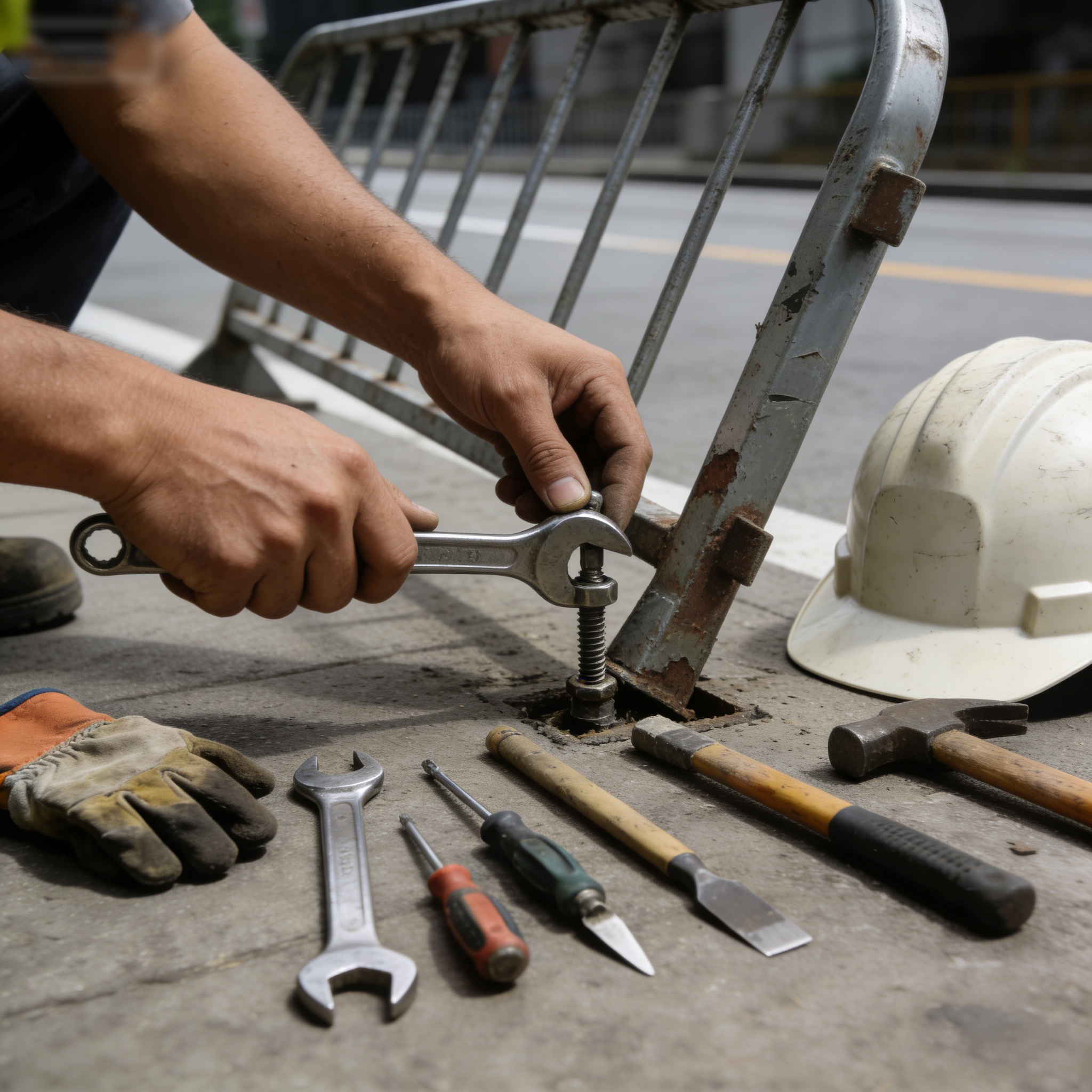
The old safety barrier is sitting there, ugly and taking up space. Want to remove it? Don’t panic! You don’t need to hire a professional and spend a fortune. You can do it yourself! It’s simple, brainless, and you can even unlock the “Demolition Expert” achievement along the way!Write compelling product descriptions for your safety barriers that will make customers want to buy immediately!
First, gather your tools. Nothing too complicated: a screwdriver (bring both Phillips and flathead screwdrivers, in case the screws are stubborn), a pair of pliers, and a pair of gloves (essential! Don’t be lazy; they prevent cuts and dust, otherwise your hands will feel like you’ve touched coal). If the barrier is heavy, find a helper to assist, so you don’t get frustrated trying to move it.How to Choose a More Eye-Catching Color for Traffic Guardrails
Once you have your tools, first “untie” the barrier. Check if it’s connected to the wall, pillars, or ground, for example, by wires, clips, or screws. Dismantle these connections first. Don’t pull hard, or you might damage nearby items, and then you’ll have to redo it.
When tightening screws, don’t make silly mistakes. If you can’t turn them clockwise, try counter-clockwise (I won’t go into details, everyone’s made this mistake before). If the screws are rusted, don’t force them. Use pliers to grip the screw head and turn it slowly. If that doesn’t work, apply some rust remover. If you don’t have rust remover, soaking it in some cola will also work—I’ve tested it and it works!What Height of Barriers Should Be Used in High-Traffic Areas?
Removing clips or wires is simple. Use pliers to grip and pry, and they’ll open in a snap. If the clips are too tight, use a screwdriver to pry a gap, then use pliers to pull. Don’t try to pry them open with your hands; it’ll hurt your hands and you won’t be able to open them—a complete waste of effort.
After removing the connections, it’s time to move the entire barrier. Give it a shake first to check for any loose “tails.” Make sure everything is loose before proceeding. You can carry lighter sections of the barrier yourself; for heavier ones, have someone help you lift them. Don’t try to be a hero; if you hit your foot, you’ll be out of work for days—it’s not worth it.
Don’t just dump the old railings on the roadside; pile them up in an open area first. Put any broken parts, screws, etc., in bags; don’t leave them scattered everywhere, or the sanitation workers will come knocking. If the railings are still usable, you can donate them to someone in need or sell them for scrap—you can even earn some extra money! Isn’t that great?
Finally, check the ground for any remaining screws or nails. Remove them with pliers, then sweep the area. The whole process should only take half an hour to an hour—isn’t it simpler than you imagined? Give it a try, and you’ll find that disassembling things is surprisingly stress-relieving!